
Quality checks are mandatory for every business to operate smoothly. Customers rely on consistency and trust products and services from different businesses. Nowadays, businesses are working with more complex supply chains, and quality is part of everyday operations.
Today, businesses have to manage quality while dealing with changing customer needs, new technologies, and growing operational demands. A Quality Management System should therefore be useful in everyday business, not just something maintained for an audit.
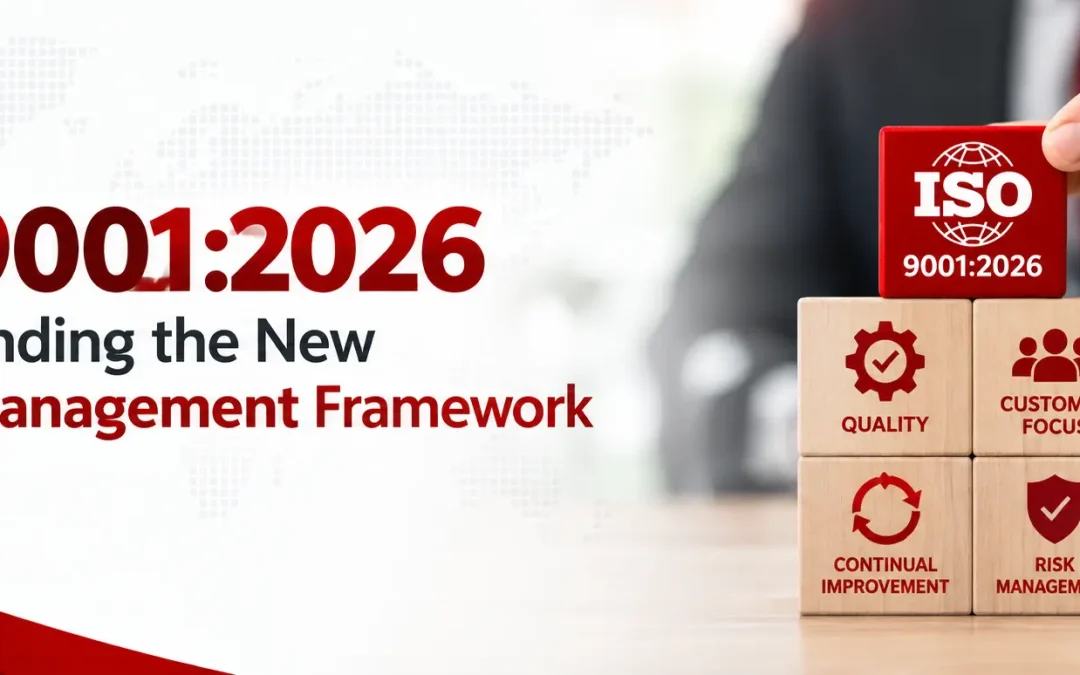
ISO 9001:2026 is the latest edition of QMS and replaces ISO 9001:2015. It includes some updates to the way organizations manage quality, risks, and improvement. The new edition keeps the basic purpose of ISO 9001 intact. It aims for customer satisfaction, process control, continual improvement, and consistent results. At the same time, it concerns leadership, quality culture, risks and opportunities, and the way organizations manage change.
For businesses already certified to ISO 9001:2015, this is a good time to understand what has changed and assess how the existing QMS needs to be updated.
What Is ISO 9001:2026?
ISO 9001:2026 is the sixth edition of the ISO 9001 Quality Management Systems standard.
It provides a system to help organizations manage processes and meet customer and applicable requirements. This system guides organizations to monitor performance and improve their operations.
The standard can be used by organizations of different sizes and sectors.
- Manufacturing company
- Construction business
- IT company
- Healthcare service organization
ISO 9001:2026 was published on 16 September 2026 and is now the current edition of ISO 9001. The revised standard does not require organizations to opt out of the quality systems they already have. Instead, existing systems can be reviewed and strengthened where necessary.
Why Was ISO 9001 Updated?
The fundamental architecture of quality management remains constant. Organizations need to prioritize customers’ needs, control their processes, and monitor performance. It will help to improve when problems or opportunities are identified. Now, what has changed in the business environment?
Organizations now deal with:
- Faster technological changes
- Digital transformation
- More connected supply chains
- Changing customer expectations
- New business risks
- Greater dependence on organizational knowledge
- Increasing pressure for responsible and transparent business practices
The new change responds by providing clearer direction in several areas. The intention is to keep ISO 9001 useful for organizations. It maintains the practical system for managing quality in a changing business environment.
What Are the Main Changes in ISO 9001:2026?
The 2026 edition introduces targeted changes rather than a completely new quality management model.
Some of the most important areas include the following.
- Greater Focus on Leadership
Quality management is crucial, and ISO 9001:2026 gives stronger attention to leadership involvement and accountability.
Top management creates an environment where quality is part of everyday business decisions. It supports the QMS and encourages employees to contribute to quality performance. The focus is therefore moving further away from being visible in the way the organization is managed.
- Stronger Quality Culture
A company may have policies, procedures, and records in place, but people also need to understand why quality matters.
The revision is important to organizational culture, awareness, and ethical behavior.
Employees need to work hard and understand that their work can affect the quality of products or services. For management, this means creating a favorable environment for employees. It helps to identify problems, communicate concerns, and contribute to improvement.
- Clearer Approach to Risks and Opportunities
Risk-based thinking has been part of ISO 9001 for years.
The 2026 edition provides clearer attention to risks and opportunities as separate considerations.
Organizations should not focus only on preventing problems. They should also identify opportunities that could improve performance.
For example, a business may identify an opportunity to:
- Improve an existing production process
- Reduce customer complaints
- Introduce new technology
- Improve supplier performance
- Reduce process delays
- Develop a new service
The important point is to connect these considerations with actual business planning and decision-making.
- Better Attention to Change
Changes within an organization can directly affect quality.
A company may introduce new software, change suppliers, expand operations, modify a production process, or introduce a new product.
If these changes are poorly managed, they can create new problems.
ISO 9001:2026 places greater attention on how changes are communicated, implemented, monitored, and reviewed.
Organizations should consider the possible effects of a change before implementation and check whether the expected results were achieved afterward.
- New Annex A Guidance
The revised standard includes a new Annex A.
It provides additional information to help users understand important concepts, terminology,y and the intent behind the requirements.
This can be useful when organizations are reviewing their QMS and deciding how particular requirements should be applied.
The aim is greater clarity and consistency in the practical use of ISO 9001:2026.
What Has Not Changed?
Not everything has changed.
The foundation of ISO 9001 remains familiar to organizations already using the standard.
Customer focus, process management, continual improvement, and evidence-based decision-making continue to be important parts of the Quality Management System.
The Harmonized Structure is also retained, which helps organizations that use ISO 9001 alongside other management system standards.
This continuity is important for organizations already certified to ISO 9001:2015.
They can review their current system, identify the areas affected by the new requirements, and make targeted improvements rather than rebuilding the entire QMS.
ISO 9001:2026 and Climate Change
Climate change is another area organizations should consider when reviewing their Quality Management System.
The consideration of climate change was already introduced into ISO 9001 through the 2024 amendment. The 2026 edition continues this direction within the organization’s context.
Organizations should determine whether climate change is relevant to their ability to achieve the intended results of their QMS.
The relevance will not be the same for every organization.
A business should consider its own activities, customers, supply chain, location,n and operating conditions when determining whether climate-related issues affect its Quality Management System.
Who Can Use ISO 9001:2026?
ISO 9001:2026 is not limited to one industry.
It can be applied by organizations such as:
- Manufacturing companies
- Construction companies
- Engineering firms
- Trading organizations
- IT companies
- Healthcare providers
- Logistics businesses
- Educational institutions
- Professional service providers
- Food and consumer product companies
- Small and medium-sized enterprises
The QMS can be adapted to the organization’s size, activities, and operational complexity.
A small company does not need to create the same level of documentation or process complexity as a large multinational organization.
The objective is to apply the requirements in a way that is appropriate to the organization.
What Does ISO 9001:2026 Mean for Existing Certified Organizations?
Organizations certified to ISO 9001:2015 do not need to start the ISO 9001 Certification process from the beginning.
Before moving to the new revised version, it is useful to take a close look at the existing QMS. The organization should check what is already working and where some changes may be needed.
- Leadership:
Check how actively management is involved in quality-related activities. Quality responsibilities should also be clear. - Quality culture:
Look at whether employees take quality seriously in their daily work. They should also understand the importance of doing things correctly and responsibly. - Risks and opportunities:
Review how the organization identifies possible risks and opportunities. Check whether appropriate action is taken when they are identified. - Change management:
Look at how changes are handled. This includes planning the change, informing the people involved, and checking the results afterward. - Organizational context:
Review the internal and external issues that can affect the business and its QMS. - Documentation:
Go through the existing documents and records. Update them where the new requirements or actual business processes make changes necessary. - Employee awareness:
Make sure employees know what is expected from them and how their work can affect product or service quality. - Improvement:
Check how the organization finds areas for improvement and whether actions are actually taken to make things better.
Conclusion: Transition from ISO 9001:2015 to ISO 9001:2026
The transition does not need to happen overnight.
Organizations certified to ISO 9001:2015 have a transition period to move to the new edition. Current ISO transition guidance states that organizations already certified to ISO 9001:2015 have until 30 September 2029 to complete the transition. The ISO 9001:2026 Transition may be carried out through a scheduled surveillance or ISO 9001 Certification audit, or through a separate transition audit, depending on the applicable arrangements.
Certification bodies should be consulted for the specific transition arrangements applicable to an organization.
Ready to Get ISO Certified?
Get free assessment faster without the usual headaches. Our platform automates the tedious paperwork and gives you clear, step-by-step guidance from start to finish.